Why Designers Still Build Sample Boards in a World of Screens
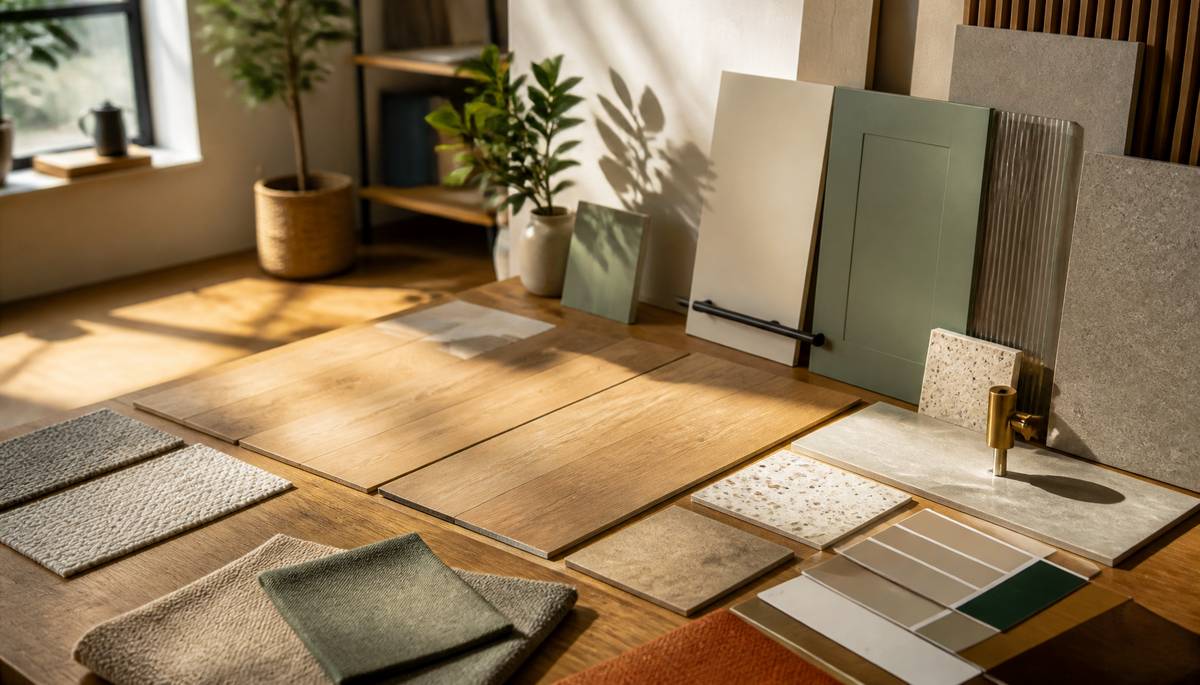 Design software can now render a room so well that clients mistake the picture for a photograph. Mood boards are built online in minutes. And yet walk into any good interior design studio and you will still find trays of fabric, paint cards, tile offcuts and pieces of flooring laid out on a table. The physical sample board has survived every new tool. There are good reasons why. A screen shows light. A sample reflects it.
A screen makes its own light. A real material only reflects the light that falls on it. That is a basic difference, and no render fully closes the gap.
It means a floor on screen looks the same at noon and at midnight. The real floor does not. It shifts with the weather, the time of day and every lamp in the room. A sample lets you see those shifts before the client has paid for forty square metres of it.
Undertones only show up in company
Most design mistakes are not about the main colour. They are about the undertone: the hint of pink in a beige, the green in a grey, the yellow in an oak. Undertones are almost invisible when a material is seen alone. They appear the moment two materials are placed side by side.
This is the real job of a sample board. It is not a collection of nice things. It is a test of whether those things can live together. A warm oak-effect floor next to a cool grey kitchen door will tell you within seconds whether the scheme works, and a screen will not.
Texture cannot be emailed
Design is not only visual. A client will walk on the floor in bare feet, run a hand along the worktop and sit on the sofa. Texture, weight and temperature are a large part of how a room feels, and none of them can be sent as an image.
With flooring this matters more than people expect. Two oak-effect floors can look identical in a photo. In the hand, one has a deep grain you can feel and the other is smooth. In a room with low sunlight, the textured one will show its grain as fine shadows, and the room will feel completely different.
Scale changes everything
A small swatch of a patterned material tells you the colour. It does not tell you the pattern. A plank floor has a rhythm of joints and grain that only shows across several boards. Herringbone needs at least six or eight blocks before the eye reads it as a pattern at all.
Good designers ask for the largest sample they can get, or several pieces, and lay them out as they would be fitted. Then they step back. Materials are almost never seen from thirty centimetres away in real life.
How to build a board that tells the truth
A few working rules make a sample board far more useful.
- Use real proportions. The floor is the largest surface in a room, so it should be the largest sample on the board. The accent colour should be the smallest.
- Lay it flat. Put flooring samples on the floor and wall samples upright. Light falls on a horizontal surface differently.
- Take it to the room. A board judged in the studio is judged in the wrong light. Carry it to the site.
- Look three times. Check it in morning light, late afternoon and under the evening lamps.
- Photograph it. A photo of the board in the room is a useful record when the client asks, six months later, why a colour was chosen.
The client sees it differently too
There is one more reason the board survives. Clients trust what they can touch. A render asks them to imagine. A sample lets them check. Decisions made over a physical board tend to be faster, and they tend to stick, because the client has seen the real thing and agreed to it.
It also protects the designer. If the fitted floor matches the approved sample, there is no argument later about what was promised.
Samples are easier to get than they used to be
The practical barrier has mostly gone. Most suppliers will now post samples direct, and many flooring retailers let you order LVT samples online in a couple of minutes, several shades at a time, so a board can be put together within days rather than weeks.
The tools of design will keep changing. But a room is a physical place, lit by real light and lived in by real people. As long as that is true, the surest way to know how a material will look is still to hold a piece of it in your hand.
|
|

