International Trade Shows Without Chaos: Essential Formalities Worth Planning Ahead
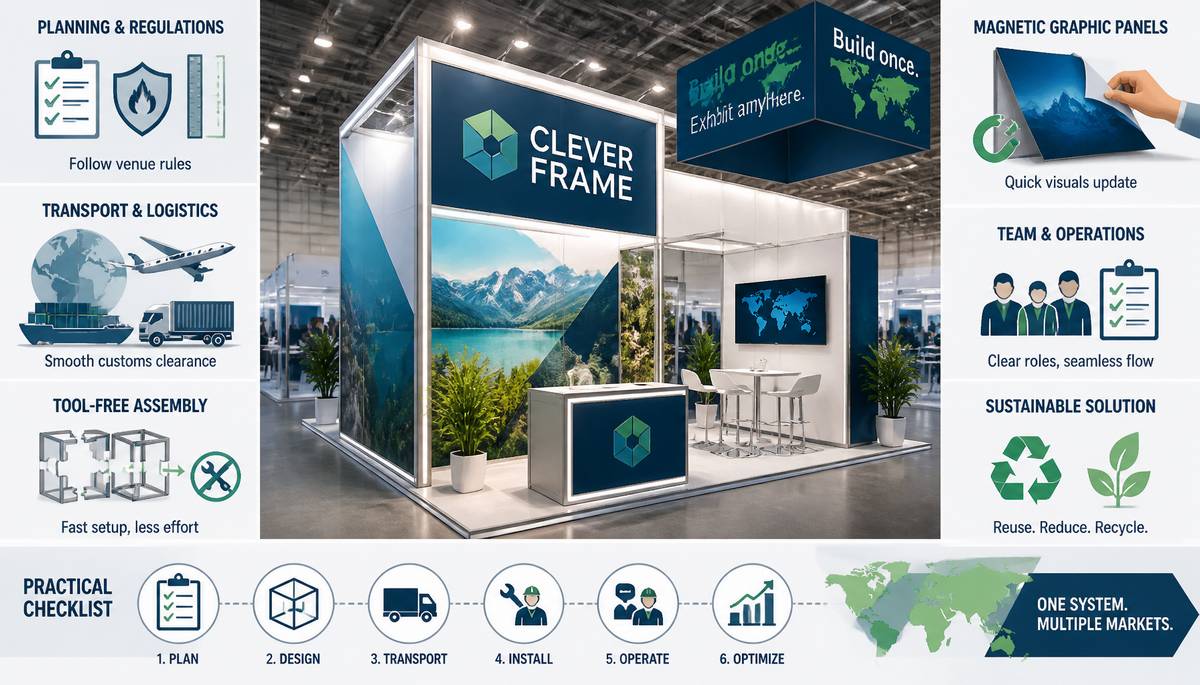 Participating in international trade shows is a strategic opportunity for many B2B brands. Global events make it possible to reach new audiences, strengthen brand visibility and understand how the company’s offer compares with competitors in other markets. At the same time, foreign exhibitions require precise logistics and a clear checklist of formalities that determine whether the booth is ready on time and whether the team can work efficiently. The further the event is from the home market, the more important structured planning becomes.
Modular trade show booths by Clever Frame support this approach by helping brands prepare their displays for different regulatory environments and varying organisational requirements. Fast tool-free assembly and disassembly, the ability to reuse the same modules and a magnetic panel system that enables quick graphic changes give teams more operational comfort when dealing with international formalities.
Participating in international trade shows is a strategic opportunity for many B2B brands. Global events make it possible to reach new audiences, strengthen brand visibility and understand how the company’s offer compares with competitors in other markets. At the same time, foreign exhibitions require precise logistics and a clear checklist of formalities that determine whether the booth is ready on time and whether the team can work efficiently. The further the event is from the home market, the more important structured planning becomes.
Modular trade show booths by Clever Frame support this approach by helping brands prepare their displays for different regulatory environments and varying organisational requirements. Fast tool-free assembly and disassembly, the ability to reuse the same modules and a magnetic panel system that enables quick graphic changes give teams more operational comfort when dealing with international formalities.
Planning participation in international trade shows
For international events, early planning is essential. Booking the right exhibition space, reviewing the organiser’s regulations and understanding local requirements prevent last-minute surprises. Each country has its own technical and administrative standards that influence how the booth must be prepared.
Organiser guidelines and local regulations
Most organisers provide detailed technical manuals specifying height limits, permitted materials, fire safety requirements, mounting rules and working hours. A modular booth concept makes it easier to adjust layouts without designing a new structure from scratch. The construction can be expanded, reduced or reconfigured to meet the venue’s technical constraints.
It is also important to verify practical differences between venues: types of electrical connections, weight restrictions for booth elements or regulations affecting installation. Lightweight frames and interchangeable graphic panels simplify compliance with these conditions and reduce logistical risks.
Formalities related to transport and logistics
Preparing a booth for an international show involves various logistical and administrative tasks. A predictable modular structure with repeatable dimensions helps streamline transport, packing and documentation, especially when materials are shipped across borders.
International transport and customs procedures
For events outside the European Union, customs documentation becomes key. Well-prepared packing lists and clear descriptions are essential for smooth border clearance. Repeatable module sizes make planning more predictable and reduce the risk of delays.
Travel times may differ significantly across regions. Lightweight components and the option to split the shipment into smaller transport units increase flexibility and reduce the chance of complications.
Preparing the booth for onsite installation
Installation schedules at foreign trade shows are often tight. Tool-free assembly allows teams to focus on arranging the display rather than dealing with technically complex construction work. This becomes particularly important when the organiser limits working hours or the number of people allowed onsite.
Managing visual elements
International exhibitions require flexible communication adapted to the local market. A magnetic panel system helps replace graphics quickly, making it simple to prepare different language versions or adjust messaging for specific regions. Being able to reuse the same construction while updating only the visuals strengthens long-term brand consistency.
Team coordination and documentation management
International trade shows require seamless communication between all team members involved. Schedules, task lists, technical documents and contact information should be accessible to everyone. Transparency becomes particularly important when part of the work is managed remotely.
Role distribution and visitor flow
Clear role assignment supports efficient booth operation. In well-planned modular layouts, each functional area can support a specific stage of interaction: greeting visitors, conducting demo sessions or holding detailed discussions. This helps the team avoid improvisation and operate smoothly even during busy hours.
Sustainability and responsible preparation
Environmental aspects are increasingly relevant across many exhibition markets. Some countries introduce limits on single-use construction or materials that are difficult to recycle. Modular booths align naturally with these expectations: one set of components can be used repeatedly in different configurations, reducing waste and extending the lifespan of the structure.
Interchangeable graphic panels also contribute to sustainability by allowing brands to modify their messaging without producing new structures for every event.
A practical checklist of formalities
Checklists are one of the most effective tools when organising international participation. They should cover logistics, design, transport, cooperation with the organiser, booth installation and team planning. A repeatable modular base makes many of these tasks easier because the construction remains constant and can be adapted to various layouts and markets.
For brands active across several regions, this repeatability is particularly valuable. The same modules can be assembled into multiple configurations depending on booth size or the event’s profile, while only the visuals require adaptation.
More information about flexible booth configurations can be found at https://cleverframe.com/system-properties/, where examples of layouts and modular applications across different event formats are presented.
A long-term perspective
Preparation for international trade shows works best when planned across several seasons. Brands using solutions from Clever Frame can build a consistent exhibition presence worldwide by reusing the same structural foundation. This reduces organisational risk while enabling continuous optimisation of the booth layout and communication for each market.
Such an approach supports strategic, predictable planning and allows the booth to evolve with every event instead of being redesigned each time.
|
|

